What it sees with, and what it cannot see
One sensor cannot read a bed. Thermal alone mistakes the residual heat of an empty bed for a person; radar alone picks up the static reflection of an empty bed as a person.
Three sensors
| Sensor | What it gives | Limits |
|---|---|---|
| Thermal | Movement · skin-surface temperature · whether a body is visible | The resolution is too low to recover posture or expression. Under a blanket, far less of the body's heat comes through. |
| Radar | Whether someone is there · a movement axis independent of heat | The static reflection of an empty bed can read as a person. |
| Microphone | Cough · snoring · vocalisation · moaning · how long speech ran | It hears the room, not the bed. Sound from the next bed or the corridor may be mixed in, so a sound that was heard is never stated as the patient's. |
How sound is handled
Sound is classified on the device. What gets thrown away matters more than what gets counted, so every group is published here.
| Group | What it does | Classes |
|---|---|---|
| Discarded | gives up on ruling at all — it does not invent a name | Television · Music · Radio |
| Marked contaminated | detects, but records that the next bed or corridor may be mixed in | Speech · Walk,footsteps · Door · Slam · Knock |
| Counted | names whichever component dominated | Cough · Throat clearing · Sneeze · Wheeze · Snoring · Gasp |
| Acute · pain | counted separately | Screaming · Crying · Yell / Wail,moan · Groan · Whimper |
| Logged only | kept out of any score or judgement — there is not yet enough measurement to set a threshold | Shout · Grunt · Sigh · Gargling · Hiccup · Creak · Rustle · Shuffle |
No visible-light camera is used
With no visible-light camera, a face, a skin tone or clothing never enters the signal at all. What the thermal sensor records is a temperature field. That does not mean nothing is kept: in the current development build, raw temperature frames stay on the device for 60 days by default, while what travels to the server is figures and event records.
What a person looks like on thermal
Below are temperature frames recorded by a real device. We collected them ourselves during development; they are not a patient record. All four are drawn on the same temperature scale (24–34℃) and averaged over 60 seconds — rescaling each scene would make the contrast a lie.
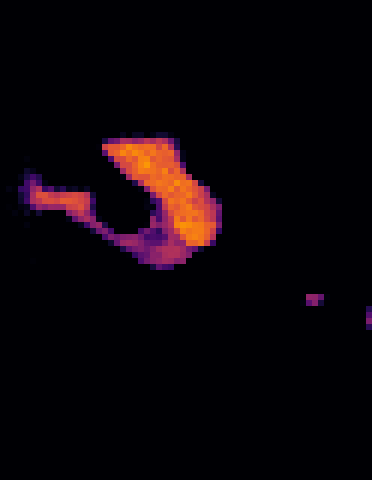



A person lying under a blanket (+3.0℃) is colder than the residual heat of an empty bed (+5.0℃). Three minutes before they left and just after, the peak temperature differed by 0.24℃. In this case the peak thermal value alone could not tell the two states apart. That is why radar sits beside it as a separate check — and why we do not claim the two sensors together catch every exit.

Three minutes, sped up. Someone standing in the room lies back down. The whole body is about twenty pixels across — no features, no expression, no identity.
The preceding 10 seconds are averaged to hold down pixel noise (±1.8℃ → ±0.8℃). Nothing else was touched.
What gets written down is decided by rules
A learned model is used to tell one kind of sound from another. But what counts as an event, and what gets written into the handover, is entirely rules. If you cannot explain afterwards why it picked what it picked, it cannot be used in care. None of this stands in for a diagnosis or a clinical judgement.